![[Logo]](gif/logo.gif)
Step rates for the CY545 are chosen from the CY545 Step Rate Table, which appears at the end of this section. Selections for the starting rate are made by the value of the First Rate (F) parameter, and selections for the slewing rate are made by the value of the Rate (R) parameter.
Each rate parameter value acts as an index into the CY545 Step Rate Table, which has 256 unique entries, ranging from a parameter value of zero to 255. Thus, for any crystal clock frequency, the CY545 can generate 256 different step rates. The CY545 Step Rate Table is shown for a clock frequency of 12 MHz, so the specified rates must be linearly scaled by the actual clock frequency when a different clock is used. The scaling factor is Fcy/12, where Fcy is the operating frequency, in megahertz.
As an example, the following commands would select a starting rate of 200 steps per second, and a final rate of 10000 steps per second, if the CY545 is operated at 12 MHz.
F 8.....200 steps per second initial
rate
R 203...10000 steps per second final rate
When the CY545 is commanded to step through a motion, by either the Go or Position commands, stepping will start at the rate selected by the F parameter. The rate will then increase regularly through the other rates in the table, until the final rate, selected by the R parameter is achieved. The CY545 will then slew at this rate until it is time to decelerate back to the selected starting rate as the specified number of steps is taken.
If the travel distance is too short to achieve the final rate, the CY545 will perform a partial acceleration, going to the highest rate possible before decelerating back to the starting rate.
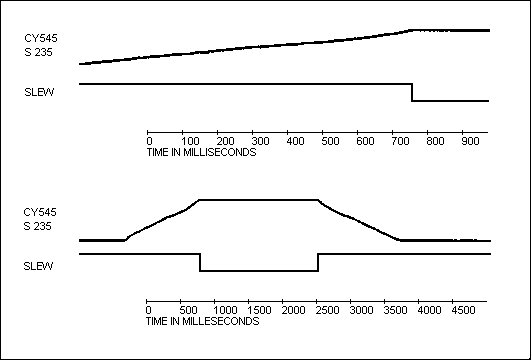
The speed at which the CY545 changes from one rate to the next is selected by the Slope (S) parameter. The value of S can range from 1 to 255, with 1 representing the slowest acceleration, and 255 representing the fastest acceleration.
For any particular application, the stepping parameter values, including the slope, are best determined experimentally when you are looking for the operating limits of the system. Each motor size, driver type, and load combination will have different performance limits. In general, the required range of step rates is known for a particular application, and will determine the values for F and R, but the acceleration value is not so easily specified.
The stepping algorithm used in the CY545 is a derivative of our CY525 algorithm, which has linear to optimal acceleration behavior over much of its range. In fact, the acceleration curve is near optimal in shape up to about 10000 steps per second. This will provide maximum performance for any motor/driver/load combination. An example waveform is shown below:
![[Optimal acceleration curve]](gif/545-57.gif)
Another feature of the CY545 acceleration algorithm is that the shape is fixed by the value of the Slope parameter (S). The acceleration curve is always the same for a given value of S. The step rate parameters merely determine where the CY545 starts stepping, and where it stops accelerating and starts slewing in the motion profile. The three parameters F, R, and S, are not coupled by the stepping algorithm, so each may be specified independently. These features are illustrated in the figure below.
![[Curves with fixed slope and travel distance]](gif/545-58.gif)
While it is difficult to provide an exact formula for the CY545 acceleration behavior, due to the complex nature of the stepping algorithm, we can provide an approximate formula. This should be used as a general guide only, with actual values determined experimentally. The formula is given by:
accel ..= ...a(s)...=...dV(s)...=...(3906 * D)...@12 MHz
........................dT(s).......(256 - s)
where
a(s).....is the acceleration in steps/second2
s........is the slope parameter value
D........is the “distance” between two adjacent
rates
.....................in steps/second, the
incremental slope
also, the ramp time is given by the acceleration and the dynamic range of step rates taken as:
t...=...|Rmax
- R0|...=...|Rmax
- R0|
..........a(s)........
. .(3906 * D)
....................... . (256 - s)
The value used for D in the above formulas must be chosen with care, since
the distance between rate points changes as you move through the CY545
Step Rate Table. D starts with a value of 25, then 50, then 35, and finally
inflects to larger values as we reach the digital resolution limit of the
CY545.
The following figures show typical performance under various values of slope, and may be used as a general guide in selecting initial operating parameters. The figures are followed by the CY545 Step Rate Table, which lists all 256 possible step rates when operating the CY545 with a 12 MHz clock.
![[Slope Curves]](gif/545-59.gif)
![[Slope Curves]](gif/545-61.gif)
![[Slope Curves]](gif/545-62.gif)
![[Slope Curves]](gif/545-63.gif)
![[Slope Curves]](gif/545-64.gif)
![[Slope Curves]](gif/545-65.gif)
![[Slope Curves]](gif/545-66.gif)
![[Step Rate Table 11MHz]](gif/545-67.gif)
![[Step Rate Table 12 MHz]](gif/545-68.gif)
![[Step Rate Table 14.75 MHz]](gif/545-69.gif)
![[Step Rate Table 16 MHz]](gif/545-70.gif)
00 Contents ..|..
01 Intro ..|..
02 Pins & Packages ..|..
03 Cmd Interfaces ..|..
04 Commands..|..
05 Motor Cmds
06 Bit Cmds..|..
07 Memory Cmds..|..
08 Prog Branch Cmds..|..
09 Mode Cmds ..|..
10 Misc Cmds
11 Circuits ..|..
12 External Memory ..|..
13 Thumbwheel Switch
..|.. 14 Output
Display ..|..
15 Proto Boards
16 Timing & Control
..|.. 17 Rate
Tables ..|..
18 Electrical Specs ..|..
19 Examples ..|..
20 Up & Running
Back to CY545 Data Sheet
© 1988 - 1999 Cybernetic Micro Systems, Inc.
All rights reserved.
CY545 Manual 22MAR99